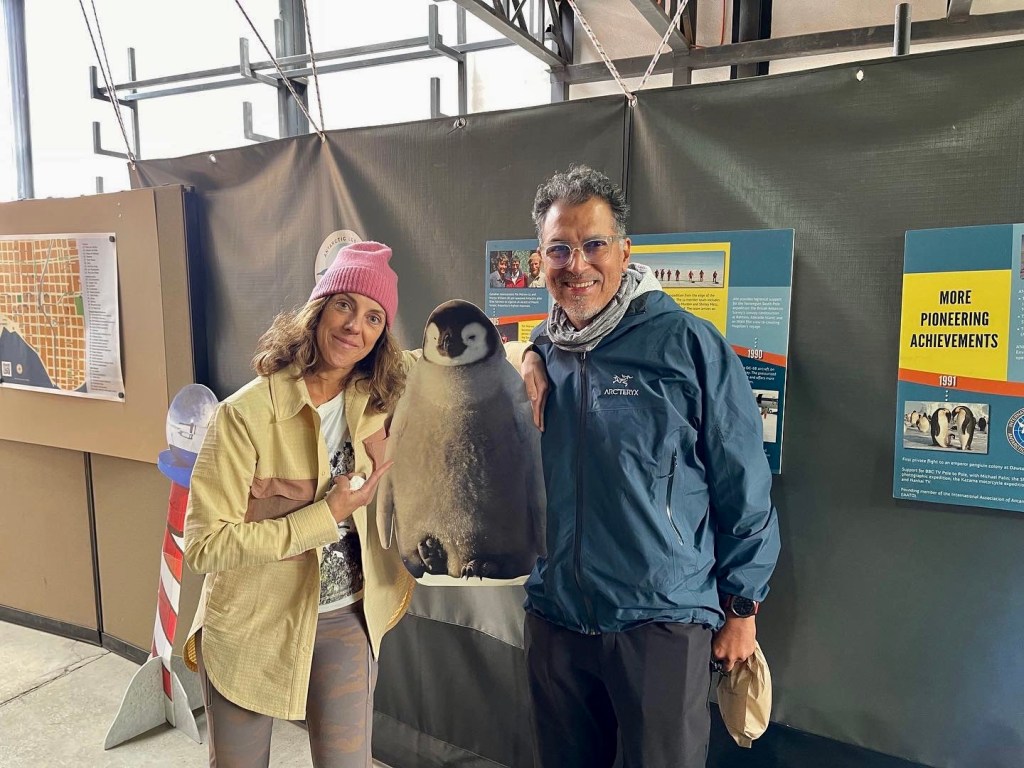
Kristi Lind, 53: runner for the last 30 years lives in Southern California. As an endurance athlete she has focused on marathon or longer distances. Ran the Boston marathon several times, completed the Abbot World Marathon Majors, participated in several full Ironman events including the World Championship in Kona. Trail runner, completed multiple Ultra distance races. Halfway thru the 7 Continents Marathons. Completed over 60 Marathons. As an athlete with kidney agenesis she endeavoured to understand the potential of nutrition and became an endurance sport nutritionist. She helped inspire and foster running as a life pursuit across all ages.
Guillermo Ceniceros, 59 (author): runner for the last 20 years lives in Southern California. Running for mind and body fitness, a travel and partner runner, support crew, photographer, storyteller. Has run the Abbot World Marathon majors, except Boston, as well as several other marathon races and is halfway thru the 7 Continents Marathons. Trail runner, completed several Ultra distance races.
- All bookmarked photos are the property of the Antarctic Ice Marathon, taken by the organization’s photographer.
Antarctic Run Expedition, 2022
An Unexpected Obstacle Race
“The actual achievement doesn’t really change your life. What you’re left with is the journey that got you to that point. If you have this big journey where you had to figure a lot of stuff ahead. If you had to plan, and face adversity and had to work hard and overcome some kind of mental barrier. What you’re left with is more of a story, a memory and an experience, that’s what’s the most important.” Marc-Andre Leclerc, The Alpinist
Foreword
Running is a wonderful way to feel fully alive. The motion gives feedback from the body, a body that is designed to run. The environment completes the stimulation. The body, the mind and the environment embrace. Few things will lift the spirit like a run in temperate weather in the Marin Headlands in San Francisco, flowing thru beautiful nature and coming in and out of views of the Pacific. Like life itself the many dimensions of a run are wasted if not lived. Running short, long, fast, slow, in different environments and places. Built around an impossible idea, a run in a place like Antarctica is irresistible, more so is an adventure. –
Few things in life excite us like Adventure travel. Going to new, far and remote places and into new cultures. Taking in amazing and rare sights. The inherent level of risk on some of these trips. The demand to travel with an open mind. Often we leave behind layers of comfort in exchange for the experience. When a trip will be physically challenging we will need preparation. Above all, we love learning something new. We learn about rare and faraway places and history. The highest value learning however is when we learn about ourselves. When we push our limits amazing things can happen. We have trekked to Mount Everest’s Base Camp, dived in the Great Barrier Reef, trekked on foot in the Serengeti, journeyed in the Sahara Desert, pilgrimaged in Varanasi and Lhasa, hiked or ran China’s Great Wall, Austria’s Mount Schneeberg, The Grand Canyon, Glacier National Park, Yosemite, Bryce Canyon, Zion, Torres del Paine and El Chalten in Patagonia. Going to Antarctica to run a marathon would be a trip of a lifetime and an adventure like no other.
Antarctica
For centuries philosophers and scientists questioned whether there may be land on the furthest confines of the South sea. Antarctica was discovered in 1820, relatively late in Human history. It would take 75 years after its discovery for the first human to set foot on the continent in 1895. It is the coldest place on earth and sees so little precipitation that it’s also considered a desert. About 98% of the continent is covered by the Antarctic Ice Sheet. It is estimated that the continent holds 90% of the world’s ice and 70% of the world’s fresh water. Antarctica’s weather is so inhospitable that only 140 people live in the continent year round. The remaindering settlements, mostly of scientific nature, come and go with the seasons.
2020, Don’t pack just yet
In early 2020 Kristi received a note from Oliver Wang, the owner of an elite racing company with whom we had run the London 2019 and Berlin 2017 Marathons. He could reserve two slots for the December 2020 Antarctic Ice Marathon. A small race limited to 60 participants he recommended an early reservation. We were very keen about traveling to the southernmost point in the world and run an adventure race. Then came COVID and international travel came to a standstill. The race would be postponed to 2021. We finished our 2020 race schedule with an October three day trail race in Utah and Arizona that had us in peak form for the cancelled race and now thinking of a 2021 schedule. We were ready for the first act, now hold our bags and come back in a year!
2021, Life gets real
The 2021 Antarctic marathon was confirmed for vaccinated travelers. Halfway thru the training schedule I started having mild appendicitis symptoms that were treated as inflammation. As the symptoms persisted I underwent a battery of tests that showed the appendix and surrounding area as severely inflamed and in need of surgery. Considered a quick in and out procedure I went in mid September with the hope of a quick recovery and return to training for the December Antarctica race. Things however didn’t go as planned. I underwent a right colectomy which is a major procedure. Ended spending 31 days at the hospital with an unresponsive Ileum and unable to digest. By the time I was discharged I had lost 25 pounds, much of it muscle. With a long recovery time the possibility of running in December simply slipped away. We were lucky to have the ability to postpone our 2021 participation to 2022, however it would be the last time we could push participation out. It would also be the second year Kristi would miss the race in peak form. Beyond physical fitness, a race like this lives constantly in the mind. There’s equipment, travel, and normal human worry about doing something new, the unknown. Kristi had to worry about being race ready and also about me being in the hospital. To make matters worse our Border Collie needed TPLO surgery. In December 2021 we were also in the middle of a delayed home remodel and such was the life we had, too much. We still had race numbers for 2022. Once again we would need to wait one more year.
2022, Use it or lose it
We started 2022 with big ambitions. Mine were about recovery. Kristi was signed up to run the Miwok 100k trail race in May. She was running big volume as is required to do a 100k race in the mountains. I was relearning to run and slowly conditioning the body. At Miwok Kristi was having a solid race when around mile 40 she missed a course marker and ended up too far out to make the next time limit cutoff. She ended running close to 50 miles that day. Miwok is not only one of the hardest US trail courses but it also demands a fast race to finish before night. Despite the Miwok mishap Kristi was running strong, she looked to be in great condition.
Life gets real, again
I continued my slow training realizing that I was starting way behind my regular running condition. In July and during an emotionally devastating trip to Mexico City to say goodbye to my deceased brother I developed a gallbladder blockage which sent me to the emergency room. As they lowered the heat on my acute pancreatitis I was allowed to travel back to the US and straight into the hospital to have my gallbladder removed. I was back in a recovery room that could have been the same one I was in 11 months ago. This time the procedure and recovery set me back 5 training weeks.
Jeopardy
On the second week in October, 8 weeks before the 2022 Antarctica race, we were on a mid week short run when Kristi heard and felt a pop in her right knee, followed by sharp pain. She couldn’t run but could walk. The following day she tried again and just could not run. She immediately started setting the medical wheels in motion to get a complete diagnosis. After about two weeks and thru an MRI scan she had confirmation of both a meniscus and VMO tears. These were non-running tears, she had to rest for a minimum of six weeks to try and slow run again. This timeline would put her right up to marathon day and without any assurance. She immediately got in touch with knee and sports specialists and started to draw a plan. The all hands on deck approach had her seeing a Rolfing Doctor, a Cryotherapy specialist, a sports Orthopedic and a Breathing Specialist who would attempt to teach her how to run with a knee injury and recruit other leg and body muscles to compensate and protect the injured knee.
It was too late to cancel travel and race postponement was not a possibility. Kristi was left with only a short time window to partially heal. If she was stressed about this she didn’t show it, and I know she was. This is a quality Kristi has, she knows that the life you have is what’s in front of you and what you do with it. Part of this confidence also comes from having run 60+ marathons. A slow race and some pain was not going to scare her. Meanwhile, thru my recovery training I had managed to complete three slow long runs and felt that I could complete a marathon. Very far from the peak condition we had in the years prior we were somewhat ready to beat the odds and have an adventure nonetheless.
Pre-planning the Expedition – weather and gear
With all the running experience we had, none of it was in temperatures lower than 25F. We live in Southern California and trained thru a warm summer for Antarctica! Going thru the weather information from prior Antarctica races as well as the current forecast we knew that at Union Glacier, the marathon location, in the Southern Hemisphere’s summer during the second week in December of 2022 we could expect temps on race day anywhere from -15F to 10F. This of course would be the ideal weather window that the race organizers would target, meaning a moving date. However this being Antarctica weather patterns can change anytime and quickly. The extreme wind was also a factor to keep in mind as it could drastically lower temperatures. It is no wonder we had to sign a liability waiver for the race as well as buy travel and medical insurance that included extraction from the continent. The waiver and the insurance were mandatory. Just two weeks before the race the temperatures at Union Glacier hit -45F!
A Norwegian friend once told us that extreme cold didn’t exist, just poor clothing choices! Typically running is a sport that does not require a lot of thinking when it comes to gear, four items; sneaks, socks, shorts and a t-shirt. Simplicity that one can love. Running in extreme cold would require different planning. The one thing to target was to keep DRY! Sweat turns into cold moisture that one does not want to have against the body. When running, the body will generate a lot of heat and sweat. The goal of the gear would be to allow for the sweat to evaporate while using the body heat to keep warm under the running layers. Sounds straightforward, but it isn’t as simple. Time to call our cold weather gear expert, our friend Gary who lives in Minneapolis and trains for several snow sports during the harsh Minnesota winter.
The recommended gear included nothing that we had on hand. We would need to have a combination of items that could allow layers for different scenarios; extreme cold, very cold and very cold and windy. In Antarctica all of these could happen in the same day. We had proper warning for the equipment needed from the race organization as a list of recommended gear was provided with proof of receipt signature required. From top to bottom we would need a baklava for the head, a warm knit beanie, snow goggles, a warm neck buff, a dry-fit top under layer, a dry-fit plus wind protection second under layer, a warm underlay such as a light fleece, a wind resistant shell with hood, thin hand gloves, warm hand mittens, cold weather tights under layer, wind resistant outer layer pants, moisture wicking under layer socks, outer layer wool socks, water proof running shoes. All of this gear times TWO to have the ability to layer up or down and change if or when items got wet and cold. Additionally we would need to have sports powder to keep the feet dry, vaseline and sunscreen to keep exposed face skin from UV exposure burning as well as anti-chaffing cream. Gary recommended gear from the Swedish brand Craft, designed for alpine sports. Amazing to see the fabric technology that allows for quick moisture wicking and drying while keeping the warmth. He also recommended what is called the wind barrier brief. This brief has a front layer that protects the nether parts from the possible effects of freezing winds. Have to admit, something I haven’t had the need to think about. All our race running gear was then packed in carry-on bags to bring on board and avoid the possibility of disaster if the airlines lost our checked luggage.
Travel
As the race was scheduled to happen on the second week of December, we set out to travel on December 7th to start our journey. Our destination was the Chilean port city of Punta Arenas which served as the expedition Base before traveling to Antarctica. We would take three flights to get to Punta Arenas; Los Angeles > Dallas, Dallas > Santiago, Santiago > Punta Arenas. On our way to the Los Angeles International Airport we received a notification from our carrier that the inbound flight for our connection was severely delayed. Losing our first connection would mean changing all our outbound flights and losing the first day and race briefing in Punta Arenas. A savvy traveler, Kristi immediately called the airline to change our first leg to depart from Orange County. The airline found us seats and we high fived for overcoming the first travel obstacle. The second travel leg was delayed one hour, we hoped that it would be time made up in the air but it wasn’t. After 11 hours of flight we arrived in Santiago and ran thru immigration and customs only to barely miss our next connection. We were stuck in Santiago for one day and would miss the race briefing. Luckily for us we got to watch world cup soccer that day. The day after we traveled to Punta Arenas and transported to the Almasur hotel, where the race Directors and runners where staying.
Punta Arenas
From the moment we arrived in Punta Arenas on Tuesday there were mandatory steps to take and all eyes were on incoming email information from the race Director. On the first day we needed to check-in at the Antarctic Logistics Expeditions (ALE) office a few blocks away from our hotel. At ALE we would be picking up our extreme cold gear consisting of massively large padded pants and jackets as well as mid ankle snow boots. This was the gear that we would need to wear anytime we were outside the tents in Antarctica. As we arrived at ALE we were directed to a station were we took our first COVID test. We had made all attempts to travel safe and had masks during our air travel most of the time. However, during the overnight flight into Santiago we were seated close to a passenger who rough coughed all night long. For a minute or two we were nervous that one incident could have us grounded, however after four minutes the results came in NEGATIVE! We tried on the cold gear and folded it into a large ball with a packing belt to walk back to the hotel. The gear was larger than our travel backs! We had a laugh walking back with the unruly packages. The trip to the coldest continent in the world was feeling very real.
That afternoon we went for a short six mile run to loosen up and have an assessment of Kristi’s knee. After a slow warm up and around the half point Kristi’s knee started to seize up. She would run a short distance and she would need to stop. It was devastating to see that all she had done, the healing time period, the treatments, a cortisone injection to the meniscus, all of it wasn’t working. She slow ran the last mile back to the hotel without saying a word. I know she was in great pain and contemplating what running a marathon distance would do to her injury. That night on our way to dinner we walked by the Shackleton bar, it reminded us of were we were. During dinner we talked about the explorers, Cook, Scott, Amundsen, Shackleton, so many others who tried to conquer the cold inhospitable continent. We didn’t talked about the injury, somehow Kristi was going to let her knee “be” all the way to race day.
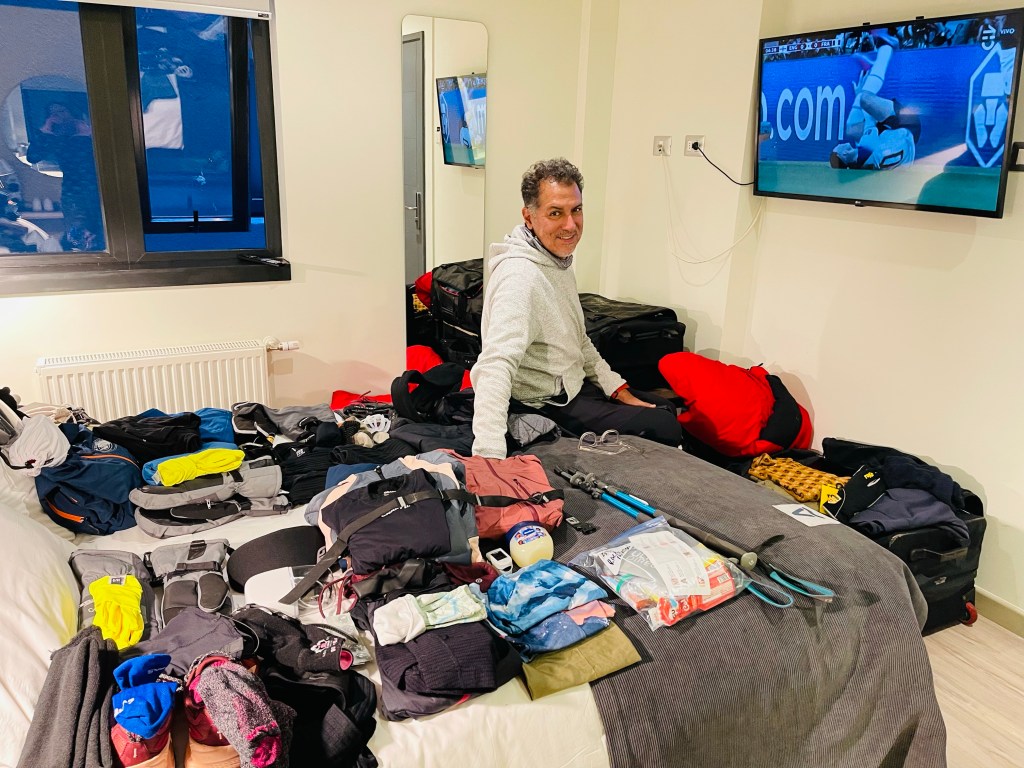
The priority for Wednesday in Punta Arenas was to secure a time slot to have our Gear-Check. The race Directors needed to check that we had all we needed. We laid all our gear on the bed of the smallest room we have stayed in. Because we had checked in a full day later the hotel gave us the only room they had left, we called it the closet room! As our gear got checked we got a big thumbs up, did not needed anything extra. We collected our race numbers and were directed to prepare a travel bag with all our running gear to be checked in early before flying to Antarctica. From that moment on we were instructed to check our inbox often and await for travel instructions. We would need to be ready to leave behind all other non necessary luggage at the hotel and only bring the necessary items as carry on.
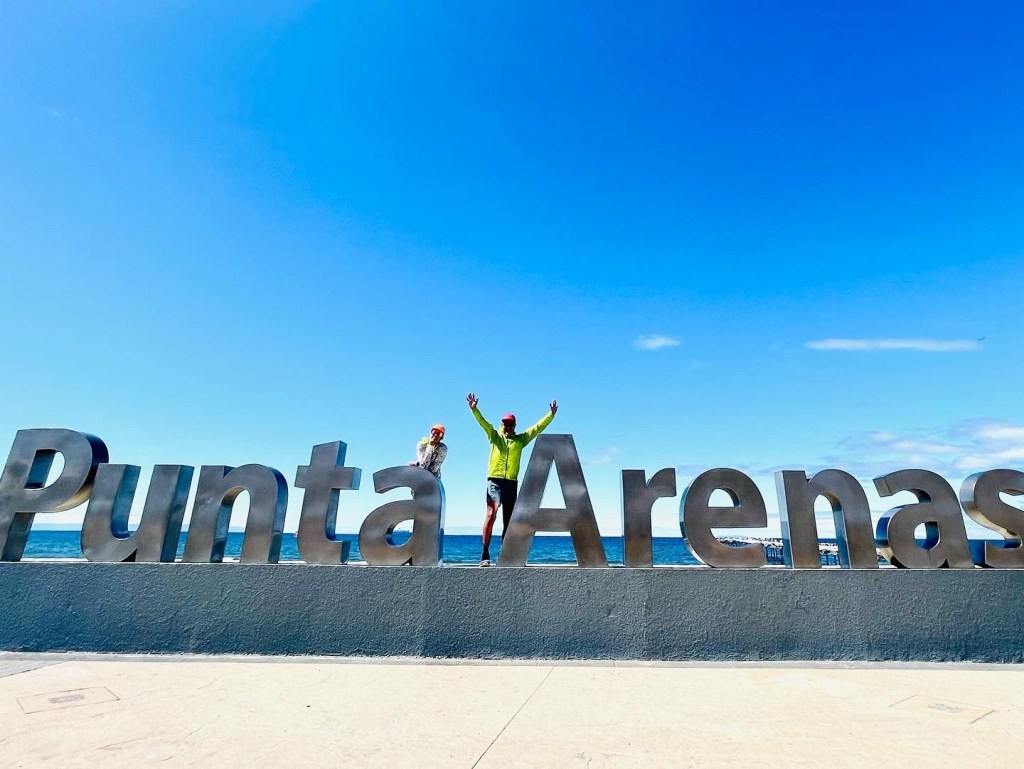

On Thursday email directed runners to check in at ALE for Friday travel and a second COVID test. Our tests were negative and we finally had our boarding pass to Antarctica! We packed up and were ready to go. The instructions were to meet at the lobby the next morning at 10:00am to check-in our running gear bags and await for transport. Like kids before Christmas we slept little and woke up full of energy. On Friday morning the entire group of runners waited at the lobby. It was a high energy environment with a large number of type A athletes overflowing with pent up energy. Some of the runners did last minute trips to the restroom, and then someone who was checking email yelled “Friday Travel is cancelled due to weather, upon further notice”. We knew that on prior races weather had gotten in the way and delayed the start day. On 2021 the race was delayed a full five days! The issue that had us grounded was a wind storm in Antarctica, which would affect air travel and race conditions. Similar to a mountain climbing expedition, the race Directors were at the mercy of weather, but hoping that their forecasts would allow a window to open. The Antarctica bound airplane would be landing on a glacier on an ice runway! No margin for error. This was not your regular weekend marathon. The weather in Punta Arenas that Friday changed as well. We had strong, hauling winds and rain the entire day and thru the night. In any other place in the world they would have called the weather at least a Tropical Storm, but in Punta Arenas it was just another Friday. We checked our email that evening and still no news. The directive was to remain ready, and look for the next update on Saturday Morning. We typically don’t drink before a race, that night however we each had a big and beautifully moody glass of Chilean Carmenere.
We’re going to Antarctica
Saturday Morning we received the final notice. Be ready by 11:00a, air travel is confirmed. Finally after three years of waiting the day arrived when we would be traveling to the continent. We would leave Punta Arenas from the international airport, going thru security and all, on a charted flight commissioned by the Antarctic Logistics Expedition company and operated by Icelandic Airlines. We would be flying on a big 757 plane. Each passenger would need to bring their big unruly package of Cold Gear clothes and boots to change into before deplaning. The temperature on the plane was lowered an hour before arrival so we could change into Cold Gear without baking. The flight would take a little over four hours, flying over the South Sea, over the Antarctic Peninsula and finally arriving to our destination at Union Glacier. The views as the plane crossed the coastline were spectacular. Ice and rock, a pristine and endless view of ice covered mountain ranges. Like landing on a different planet. Union Glacier does not have an airport, it does have however a solid blue ice area long enough for a big plane to land in as a runway. Before the use of commercial 757s large Military planes would land here for the set up and supply of the Union Glacier camp. The Blue Ice Runway is smooth, tho not smooth like applied asphalt. The landing felt a little rough, expected, and resulted in a round of applause for the pilot. We avoided sliding on the slippery ice, after all.
Union Glacier Camp
The Antarctic Ice Marathon is possible because a place like Union Glacier Camp exist. There is another race that happens on the coast of Antarctica, however it arrives in and out by boat . The Antarctic Ice Marathon is the only race that happens in an area so remote that it can only be accessed by air. The camp is located a couple hundred miles from the magnetic South Pole in the Ellsworth Mountains in a large expanse of ice that is an active glacier, the Union Glacier. ALE manages the camp and the Blue Ice Runway operating during the Antarctic summer, November thru January. Off the plane the very first thing one sees is the slippery and naturally occurring Blue Ice Runway. We landed around 4:00pm, after a few minutes of a heightened celebration state we were shuttled on massive ATV vehicles to camp. It is a short five minute ride with the beautiful Ellsworth mountains surrounding the Glacier.


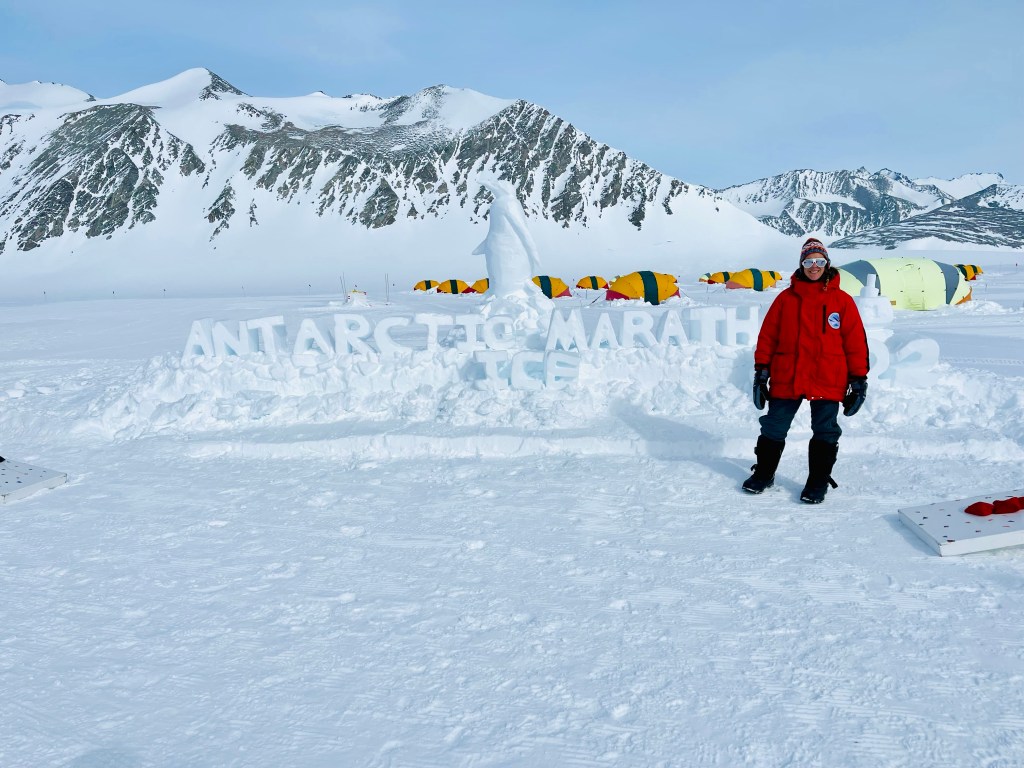

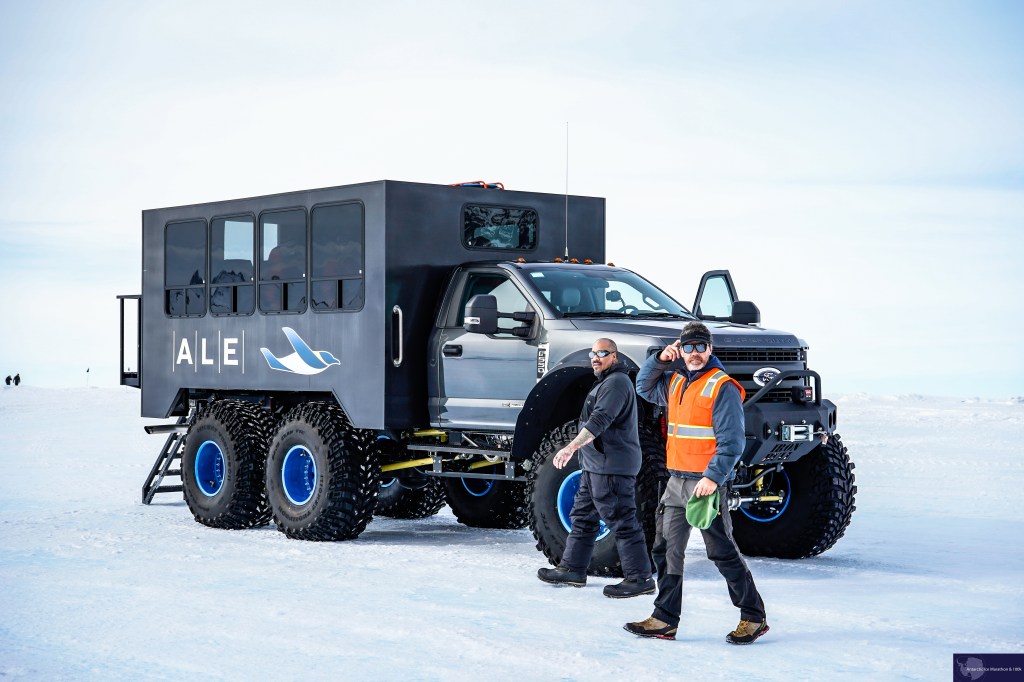
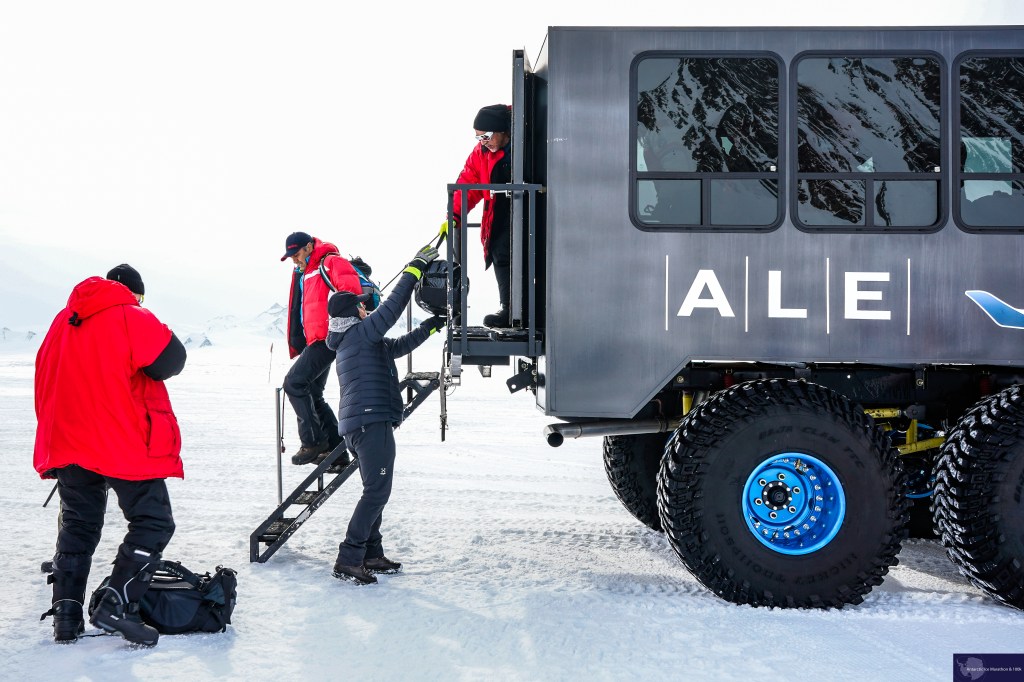
Arriving at the camp the runners were divided into smaller groups for a thorough briefing of the camp’s operation as well as its rules. Union Glacier is a full service tent camp that is completely dismantled by the end of the season. This drives the operators single most important policy, nothing is left behind. The camp is an exercise in operating minimalism that is nothing short of brilliant. The accommodations consist of double occupancy clam shell tents. There are thirty tents for the guests and about twenty for the operating staff including a camp doctor. The double walled tents are designed to be naturally heated by taking in the 24 hour summer sunlight which keeps them up to 60F. Each tent has two cots with thick sleeping bags and a small table. The tents are tall enough to be able to stand up in the middle section and as one heads to the double zippered doors. Eye masks and ear plugs are provided to sleep.

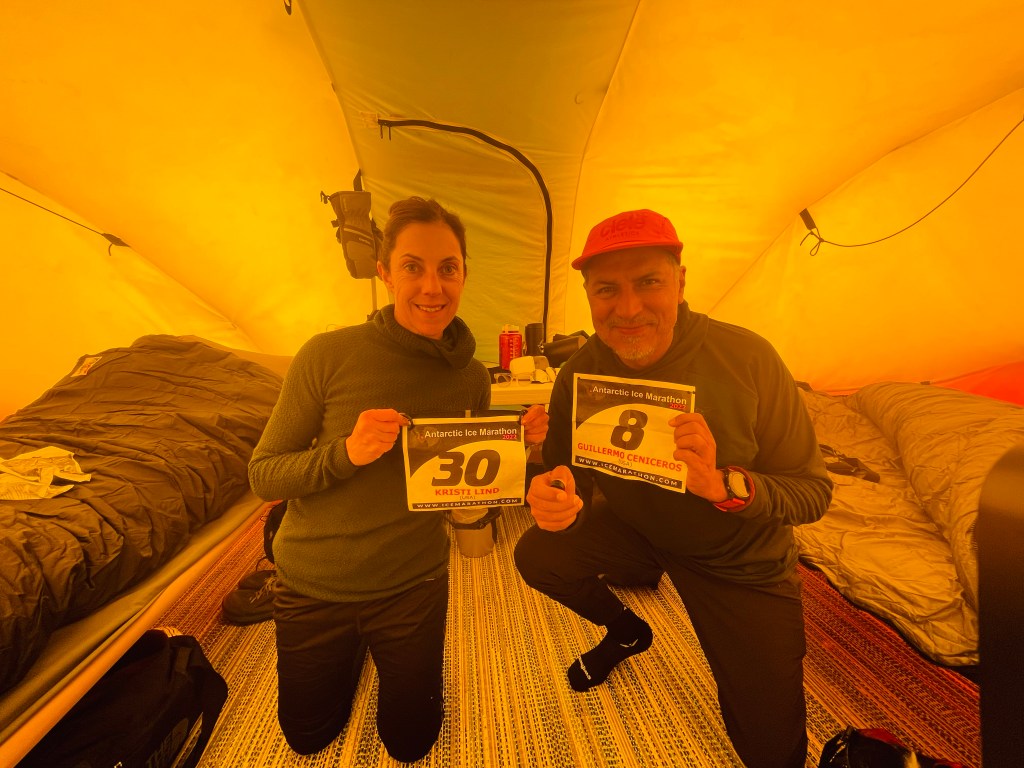
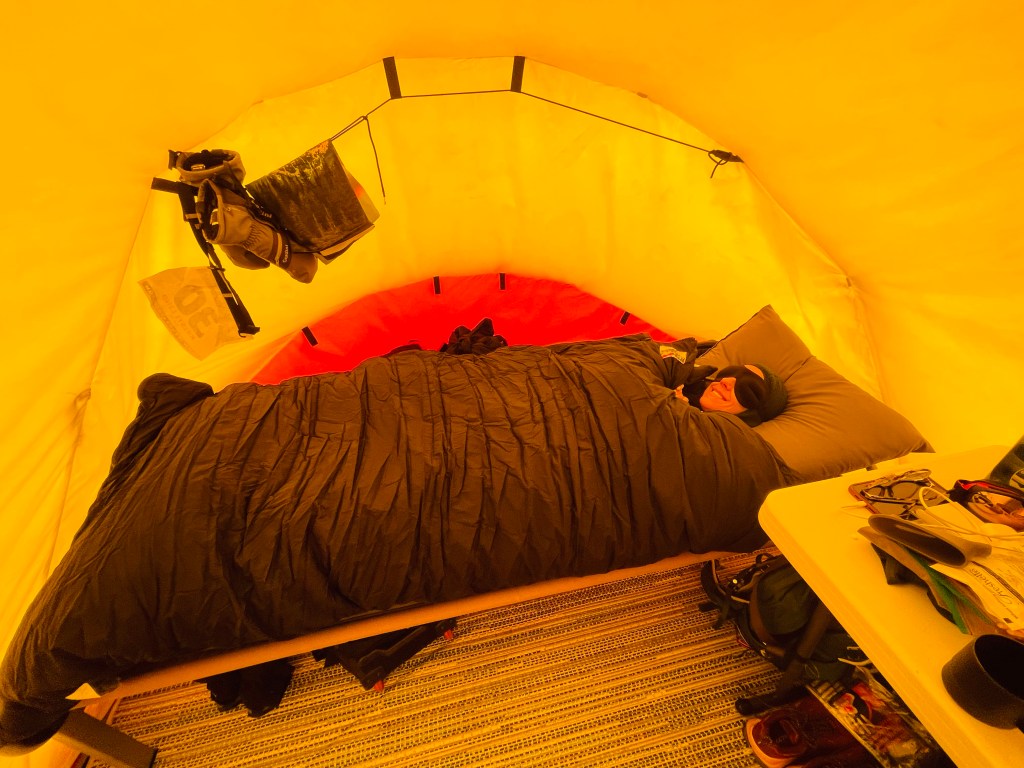

The showers and toilets are communal and are designed to minimize the amount of grey water and solid waste produced. All the waste is placed in large containers and is flown back to Punta Arenas. The bathroom area is about 100 meters from the tents, or farther depending on tent location. Having a pee bottle in the tent is a must to avoid a cold midnight walk. In the morning the pee bottle is emptied into the larger pee container. Goes without saying this is the guest’s responsibility. There are three large tents in the middle of the camp. The first one is the dining tent where three meals are served daily. The food is freshly prepared for each meal and is pretty excellent considering the location. The dining tent is also a communications point with the day’s activities written on a board as well as other group meetings and briefings happening here. A second tent is a lounge/library and the third large tent is for the camp’s operations. Also, there is no Wifi in the camp, but one has the ability to use a satellite phone for $40.00/call. The economy of the camp’s operation is completely driven by purpose. It isn’t luxurious and it shouldn’t be, yet we didn’t feel lacking. Everything around us and in our tents helped us survive in a very inhospitable place. The spartan environment helped further to have everyone’s focus on the race. No distractions, all purpose, every single item at the camp was essential in helping our group of runners fulfill our goal in Antarctica.


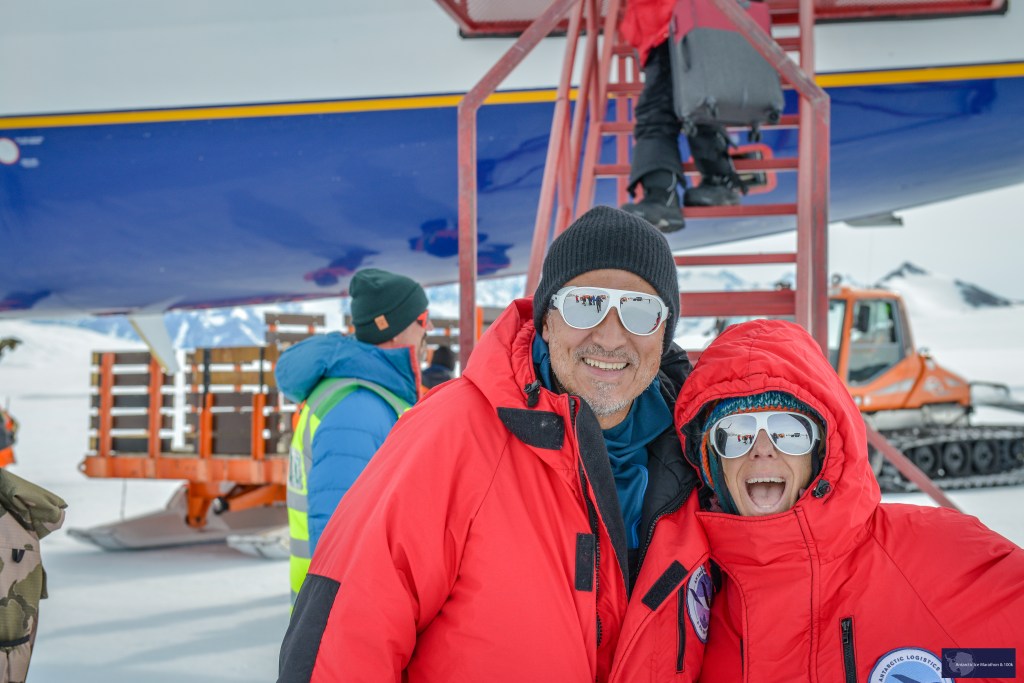
After the camp briefing and setting our things in our tent we headed to the dining tent for dinner and more briefings. Everything in the schedule seemed back to back. The dinner was perfect for pre-race, a lamb stew and potatoes and some rice. I learned not to over eat on the pre-race night many races ago, we were both feeling good thus far. We then had the all important and short safety briefing. The trapezoid shaped race course consisted of four 6.5 mile loops. The instructions were to run left of the carefully planted blue flags. This is important because the course terrain has been carefully surveyed and deemed safe to run in. Beyond the flags it may look as tho the surface is the same, however this being a Glacier it is very much possible that the ground underneath the recent snow cover is not only uneven but also crevased and deadly. The safety Director also stressed the importance of not taking the cold lightly and be sure to protect body areas that very quickly can get severely affected and even in danger of frostbite. I am sure that every race participant in that room had been thinking about protection from the cold for many months, however the remainder was good temperance for the over-confident.
Trial Run
After the briefing we were instructed to be ready for a trial run at 8:30pm. We were asked to wear exactly what we planned to wear on race day, including race numbers. There were two reasons for the trial run, first it would allow the race organizers to take photos and video in a more controlled environment, and second and most important it would allow runners to try the gear and determine what changes should be made if at all. The two mile trial run gave everyone a preview of the experience and also I believe a boost of confidence in their gear and preparation. Our friend Gary had recommended to wear fewer layers and start the race cold, warm up running and only then decide if additional layers would be needed. I didn’t follow his advice for the trial run and started with a cozy layer under my top shell jacket that was beautifully warm. At the end of two miles the same layer became awfully wet from sweat and uncomfortable. I should have listened to Gary’s advice as he was spot on. Kristi also had changes to her trial gear. She had planned to run with her trail shoes to which she was perfectly adjusted to and comfortable. Those shoes, however were too thin and light for the mushy snow terrain. The trail shoes were also not waterproof enough and could lead to wet and cold feet. She would be changing the next day to a pair of heavier fully waterproof hiking shoes that would keep her feet dry. The risk here was that she hadn’t run many miles on these thicker shoes that were designed for hiking. Unfortunately it became a question mark that would be answered on race day. We were glad to have had the trial run and the gear to feel ready for the race. We went back to our tent and as we always do before a race, laid out the exact gear we would be wearing, set an alarm and slept a few good hours.
Race day
On Sunday the race would start at 10:00am. After a night of decent sleep we were up around 7:00am with enough time to have breakfast and be race ready with time to spare. We had a small breakfast consisting of scrambled eggs, a yogurt and coffee. Never too much food as to overload the digestive system and enough to have the all important pre race bathroom stop. The day’s forecast was a combination of snow with low visibility at the start and clear and sunny in the afternoon. The temperatures would be on the higher side of the forecast of 10F to 15F, definitely below freezing however not extreme cold. The race course had two aid stations at the three and six mile markers. At the aid/bathroom stations we would be able to get hydration as well as food in the form of cookies and gummies. Camel back style hydration systems were discouraged since the dispensing tube was likely to freeze.
We started to dress and get ready, carefully thinking of all the things we would need on the course. We packed a couple of extra nutrition gels as insurance in case we wouldn’t agree with the food provided. We were suited up and ready to go. As we walked up to the race start I asked Kristi how she was feeling. She said that the two mile run the night before had been fine. Her knee, it seemed, was cooperating and she was conscious of the possibility that this would be temporary. She was also ready to slow down and recruit other muscles to help it. She was in a good mind space and we were minutes from the start.
We lined up towards the back of a very international group fully aware that we were going to have a slow day. When we are on the same race Kristi and I always run together and finish together. Many times it would have been possible that one or the other, typically Kristi, would finish much earlier. Still, we like running together, we like a race to be our experience and our moments and we wouldn’t have it any other way. Together we typically run a road marathon distance at around 4:30 more or less. Today was going to be slower, even much slower. We had run trail races where we would be on the course for nine hours, so being out there a long time would be ok. We made a promise that we wouldn’t run to the point of injury. At the start point everything around was new to us and amazing. We were elated to be in Antarctica and about to start the marathon that we had been planning for three years!
10, 9, 8, 7, 6, 5, 4, 3, 2, 1. The starting gun went off! In a quick moment the built up apprehension fades off. Like diving in and realizing that the water really isn’t too cold. With the distance ahead this was only the beginning of an adventure. It was snowing at the start, a light snow with full cloud cover that blends with the snow ground giving the impression of a white out. This white and grey environment that surrounds everything has a visual effect that creates very low contrast. Without contrast it is hard to discern whether you’re stepping into flat snow or a snow mound. The fresh snow cover became mushy and uneven. It was hard to see the unevenness tho when you stepped on it your balance was thrown. I was following the steps of the runners ahead of me as they did of those ahead of them. The line created was more likely to be flat, tho it wasn’t always. Kristi was running just behind me. I wanted to make sure that my line found flat snow ground for her too. I knew that her injured knee was going to have to work extra. There was a lot of focus on the ground in front of you, while at the same time we were finding our “all day” cadence as the goal was to finish. The first 6.5 mile lap allowed us to survey the quality of the terrain. There weren’t any parts of the course that felt like running on solid ground. It was all mushy, but dry unlike mud and mostly uneven. At least four sections were pretty bad and had our shoes sinking in. In some ways it was like trail running, or running on sand but not the same. It was running on mushy uneven snow with different levels of firmness. Even the fastest runner would be handicapped, though we all knew that this wasn’t a time record setting race. We stopped at both aid stations to drink water and grab a cookie. It was hard to gulp a bunch of water so we were drinking about two cups of water at each stop and feeling that we should be drinking more. The first lap was slow and uneventful. I could see that Kristi was stressed and running with caution.


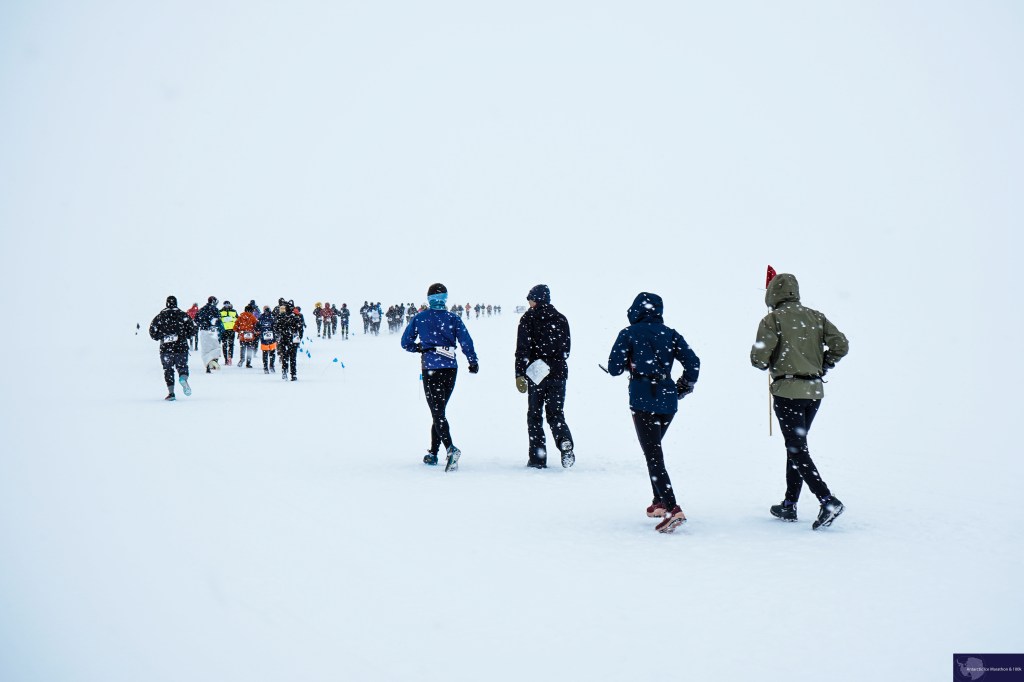


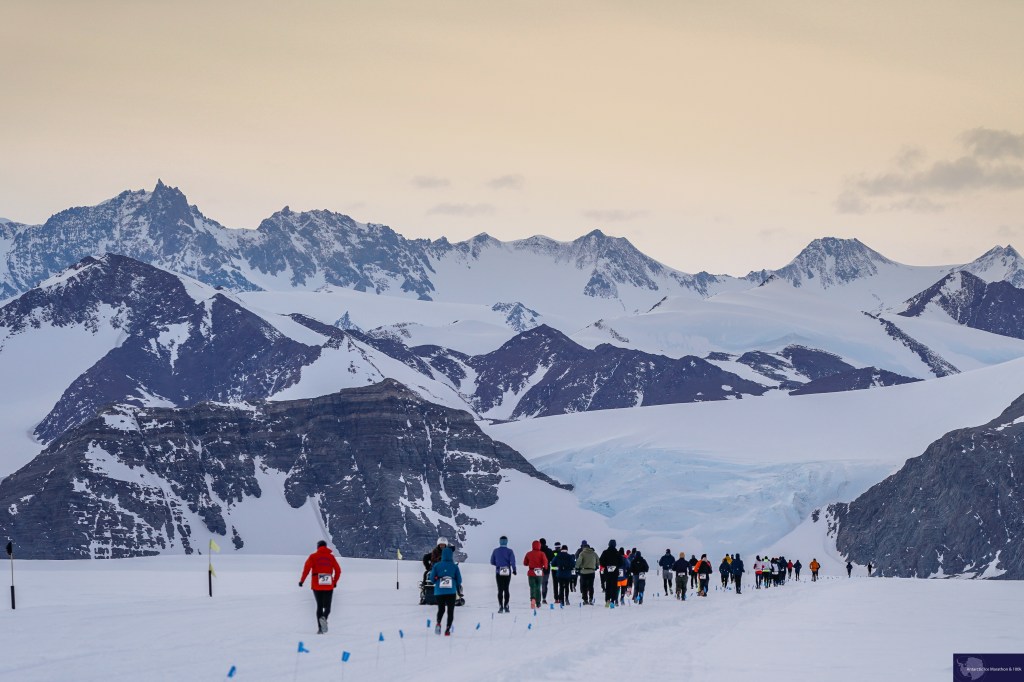
The weather cleared out as we were on the second lap. I am short of words to describe the amazing beauty of the course. There were majestic snow covered mountains on all sides. The Ellsworth Mountains, which are the highest mountain range in Antarctica. The closest set of mountains to our left was about 10 miles away, on all other sides they were about 30 miles from us. There was no color on the mountains, only the grays of rock and the whiteness of ice and snow. There wasn’t a trace of life, not a single tree, plant, bird or animal of any type, it was eerie. Beyond the camp, the signs of humanity were also scarce. By international treaty Antarctica is a no fly zone, so not a single plane in sight during the time we were out running. It was absolutely pristine, as fewer places in the planet now are. It was an irreplicable stage that we had just for ourselves as the runners staggered. I had started to feel my body temperature drop as we approached the aid station and was reminded that in the cold one needs to consume more calories to be able to maintain body heat. It would be embarrassing to admit the amount of cookies I ate at the aid station, however very soon after the cold went away. As we were closing the second lap Kristi had a knee jerk stop. Her injury had started to be more present. She would slow run a distance and then have pain shooting up on the landing motion. She was able to walk as this decreased the pressure on the meniscus. We would walk a distance and then try to slow run until her knee decided not to.


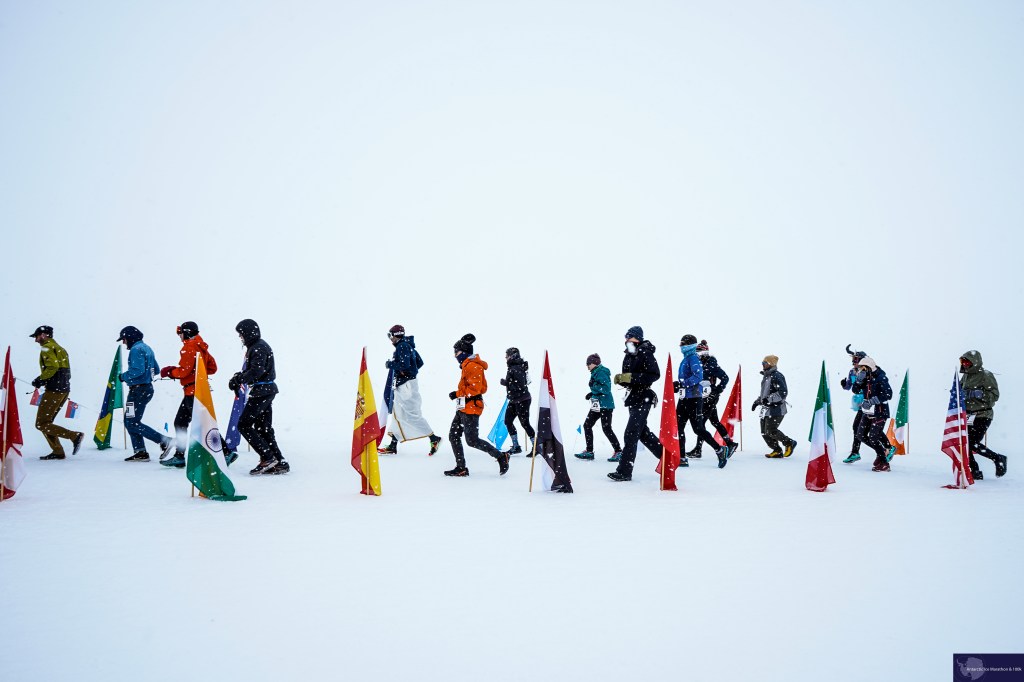
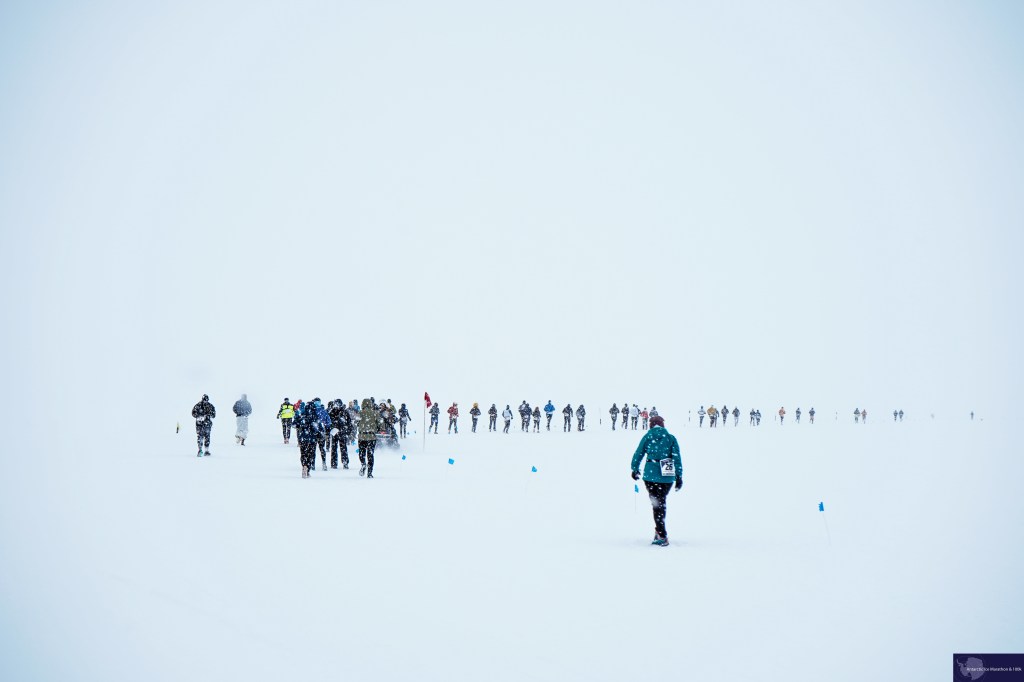

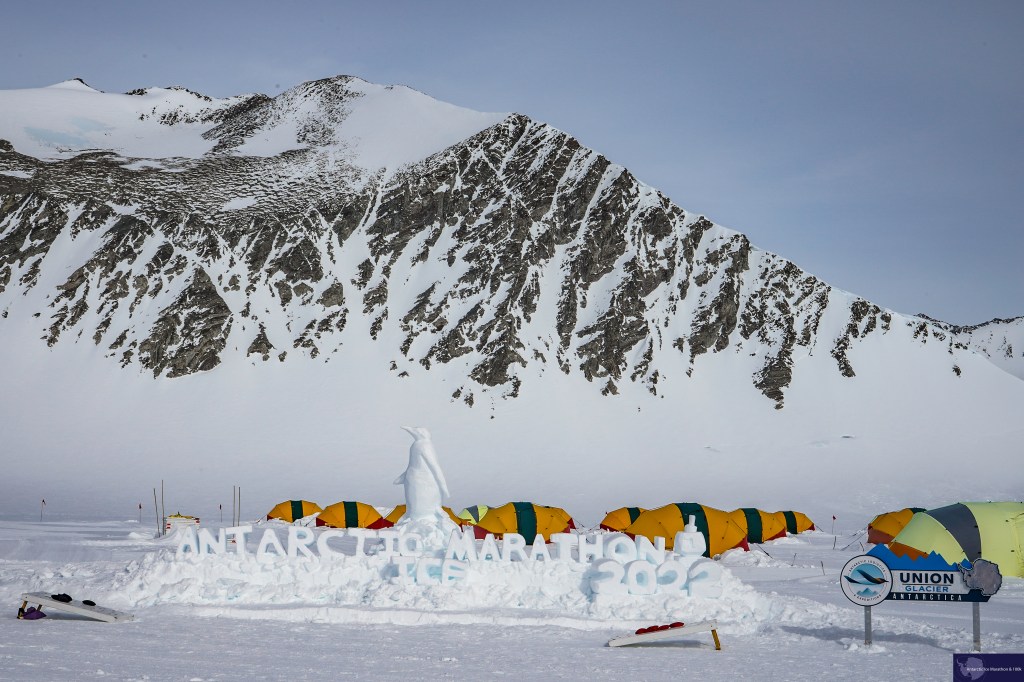
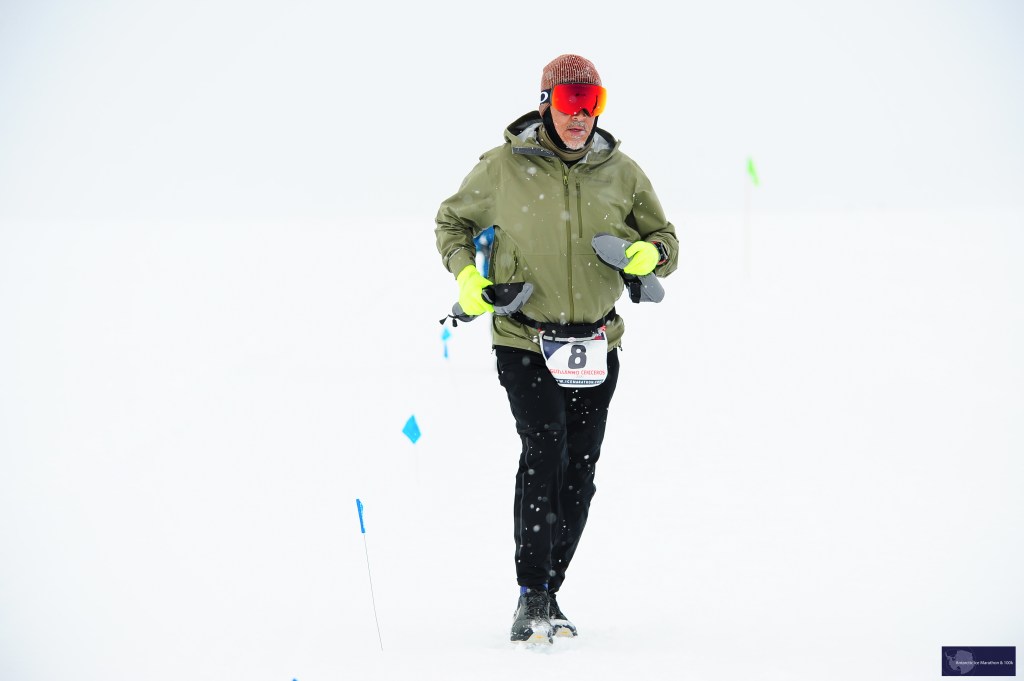

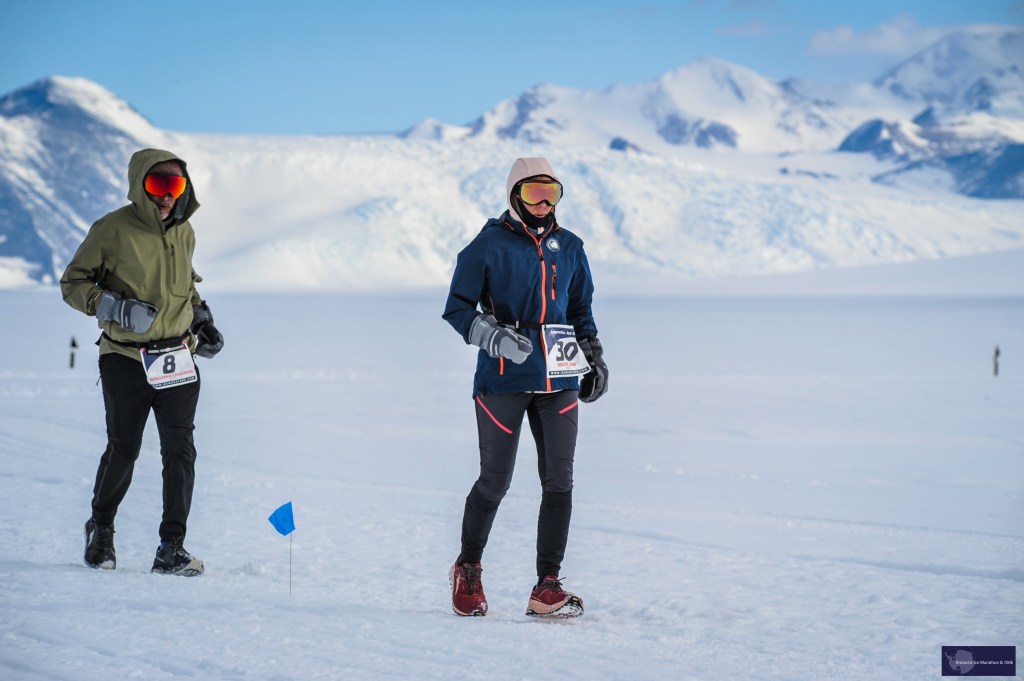


We run-walked the third lap mostly by ourselves and mostly in silence. Looking from the outside in it would look as though nothing is happening. From the inside out there is a lot going on, mostly in the mind. I could see that Kristi had shifted all her focus to recruiting different parts of her running body to compensate for her ailing knee. After doing this for a while the muscles that over-compensate start to over load as well. It’s a continuous shift strategy that aims to keep the body in motion. Whatever happens there could be no stopping, no quitting. Silence helps with this, the third lap was a hump that we had to go over. I don’t like running in pain and I think that Kristi is doing it not just because she wants to finish, but because she is brave. I am submerged in my own thoughts too. I dedicated the third lap to the memory of my brother Enrique who passed in July. I imagine his face, talking to me the way he used to, joking, that I really didn’t look that cold, or didn’t looked like I was running, he laughed. Never too many times to say goodbye. It was a quiet third lap.


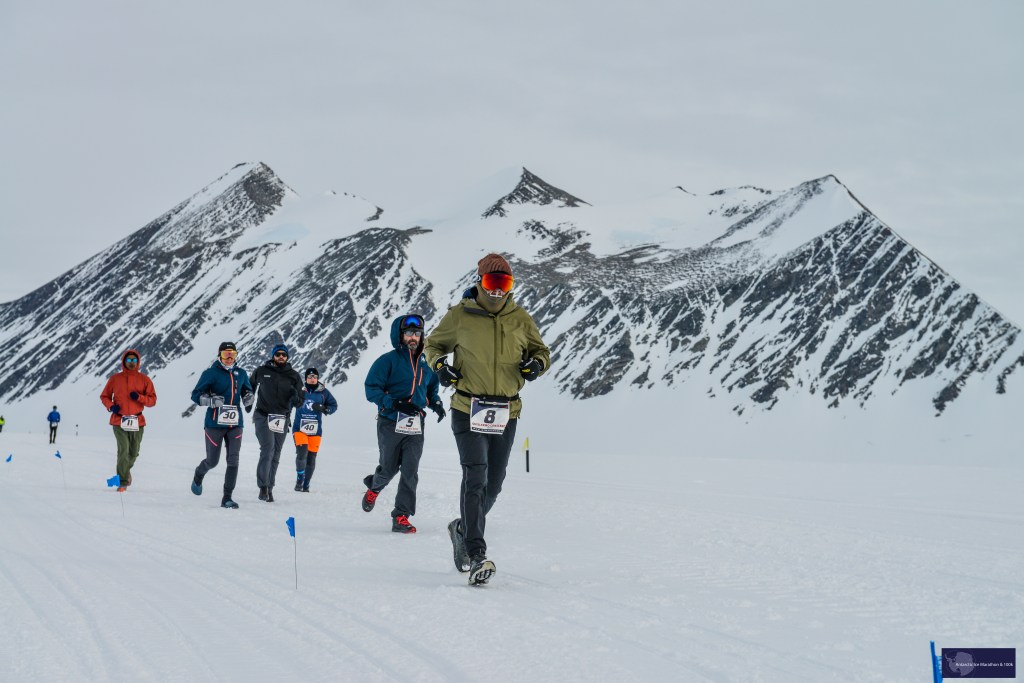


A certain sense of relief came to us as we crossed into the fourth lap. We had gotten thru three chapters of our run story and now we knew how the fourth was going to finish. A runner passed us in the early part of the fourth lap. We waved and told the runner to keep on going strong. The runner replied “I’m so over this, I’m over it”. We were taken aback by this response. Perhaps it was just the typical tired body frustration being expressed. How could anyone say that about this race? One never knows what a runner may be going thru, and frustration does happen in a marathon. Not to us, tho, not at that moment at least. We were going to finish the Antarctic Ice Marathon and enjoy every minute of it. As we run-walked in that last lap we had runners from the back of the bus catch up to us. Every meeting was a mini celebration. “Could you believe this place?” “Could you believe we are here?”. Our group of slow runners wanted to hear our story, how did we get here?. We heard that some of them were running this race as their second marathon only! One of the runners was dedicating his run to a sick relative. Another runner in the back group stopped by his tent at the end of the third lap to grab his big camera and take photos of everything that was around him. He said, “how could I not?, I may never return to this beautiful place”. He would run a short distance and then stop to take some shots. At the aid station we found a runner sitting down, done. He told us he had terrible immobilizing leg cramps. We asked him if he had taken any electrolytes, it looked like he could be very dehydrated which causes cramps. He hadn’t taken any, but we had some on us. We gave him a couple of salt tablets and told him to take with plenty of water. Told him to keep on moving and he did, all the way to the end!. The jubilant back of the bus at the Antarctic Ice Marathon, our kind of people with an attitude that gave us a big smile. And we crossed the finish line like that, grateful and happy. After three years of planning and much adversity we had finished.
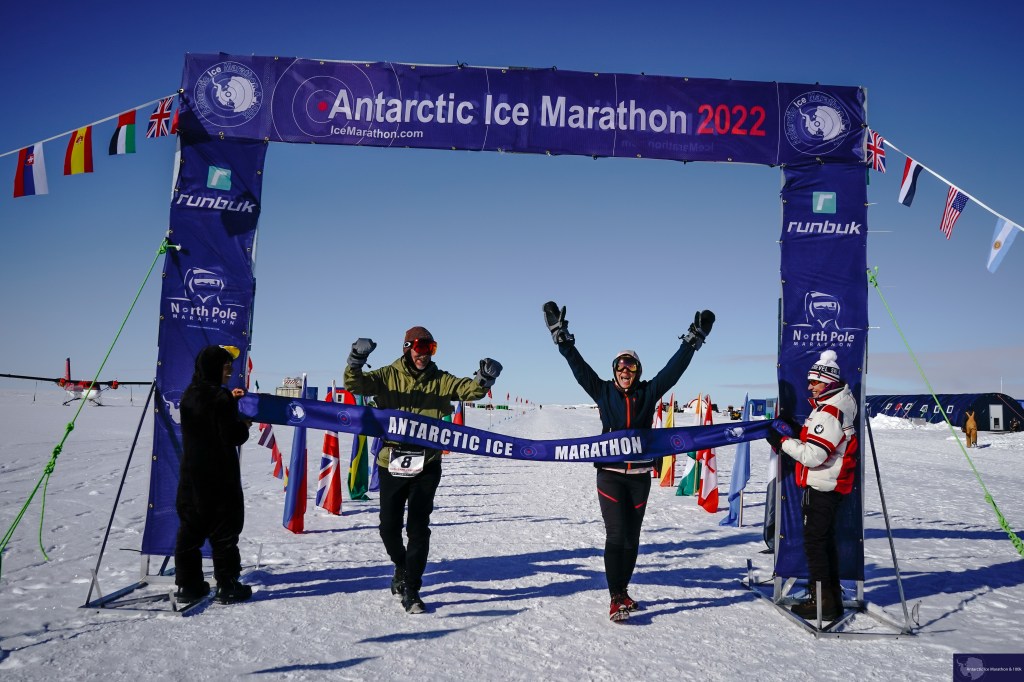

After the race we had time to shower, eat some dinner and go to bed exhausted. There was a severe wind storm that night. The wind hauled thru the camp and moved our tents, even changed the air pressure inside them. We put on earplugs and eye masks and didn’t hear anything for the next eight hours. The next day we were cleared to travel back to Punta Arenas. As soon as we got back into town we beelined to the Shackleton bar to have a big celebratory burger with a beautiful bottle of our favorite Chilean wine, Don Melchor. A proper celebration for two, and our last night in Punta Arenas.
Final Words
After eight hours the Antarctic Ice Marathon was our slowest Marathon ever. It too would be one of our most meaningful races. We were happy for those runners for whom the day went perfect, who ran injury free. That could have been us in other circumstances. Comparison is the killer of all joy. Everyone has their story, this was ours. We learned a lot from this race. Mostly that with the proper preparation and determination any adventure is possible even in a less than optimal physical state. Even in bad circumstances, participation is better than the alternative. We are now part of the less than 300 humans in the planet to have completed a marathon race inside the Antarctic continent!
The upside from having the experience and the learning was huge for us. We feel lucky to have spent time in Antarctica and see the efforts to conserve the continent’s pristine nature thru a minimalist footprint approach that is designed with purpose. In the near future we may have no choice but to live more economically to preserve our living resources and our environment. Humans don’t need to travel to Mars to learn this lesson.
For most runners they arrived back in Punta Arenas to catch a flight back home twenty four hours later. This underlined a truth and an observation that we made as we closed this chapter of our journey. For these runners it was an accomplishment of geography where they were set out to run a marathon in every continent and therefore a box had been checked. For us the motivation was deeper. Our motivation is to never stop exploring and to bring the spirit of adventure into everything that we do. We boarded a bus and headed towards Torres del Paine to continue our adventure. On that bus ride we smiled in the satisfaction of what we had just accomplished and anxiously and excitedly started plotting what our next adventure was going to be
Guillermo & Kristi
 Guillermo Ceniceros Unbound