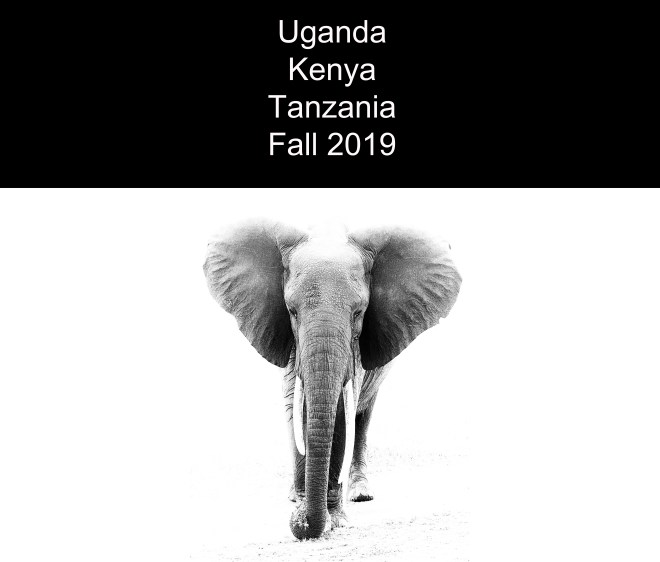
East Africa – The circle of life.
Kristi and I were thoughtful about every aspect of our 2019 fall trip to Uganda, Kenya and Tanzania. When I turned 50 we had traveled to Tibet and the Base Camp at Mount Everest, a trip that had an effect on us. For Kristi’s 50th we went over a short list of locations to have a lifetime trip, one that would leave a deep impression. East Africa kept coming to the top of our list as a place for stories, experiences and photography. We realized that the key would be in the trip’s planning to avoid getting caught in the carrousel of travelers and plan for the most authentic experience possible. Our brief to our travel planner had one word – authenticity. We wanted to avoid multi-group share rides and accommodations. We wanted to be in nature, wake up to it, sleep in the middle of it. We didn’t mind tents as long as they were safe. We wanted experienced local guides from whom we could learn not just about place, but also culture. We wanted to be out all day, from the earliest sunlight and into dark. We wanted rides where we could be fully present in a location and slow down or even go back for the possibility of an interesting photograph. We hadn’t any special food, accommodations or even wifi requests, we wanted less to get more!
As a photographer I was ready to be open, to experience and have that be my guide. I believe that it would be difficult to separate an artistic sensibility from that which allows us to appreciate nature. I continue to learn, and affirm, that nature represents the primordial aesthetic values present in anything that has beauty.
“Look deep into nature and then you will understand everything better”. A. Einstein
East Africa, a place of legend and lore. The birthplace of modern humans where we roamed for thousands of years before our migration to the rest of the world. No other place has such an extensive biodiversity of large animals and one that is so closely guarded for preservation. An area with a dark history too as one of the slave trade gateways and long term colonialism. Today the countries of the area are independent and forging their own way. In many ways their connectedness to nature and focus on preservation makes them progressive models to follow. In preparation for our trip we had been warned not to bring any disposable plastic items as these were banned and would be confiscated. We were also told that to avoid penalties our luggage, including backpacks and camera equipment, should not exceed 15 kilos/person. Laundry would be available at the camps, and after all the animals don’t care if one is wearing the same clothes for a few days. From California we could expect to be traveling for a full two and a half days via Qatar before getting to our first destination.
Uganda
Our first leg started in South East Uganda in an area bordering the DRC and Rwanda. We had travelled here to trek into the impenetrable forest and hoped to see mountain gorillas. These gorillas live in forests high in the mountains at elevations of 8,000 to 13,000 feet. Our planner picked the Mgahinga Mountain area as its challenging terrain would insure fewer people and a more demanding trek. The Mgahinga park issues only eight permits per day for an escorted/guided trek to see the gorillas, advanced planning a must. In the area we were assigned to there had been sightings of one mid size family with three silver backs, five females and five young gorillas. Park ranger trackers communicate the location of the gorillas and the park ranger guides lead the small group of visitors thru the jungle to it. The trek is at parts hiking and at parts crawling thru steep ravines and inclines to move a small distance. Once our group reached the gorillas we are allowed one hour to take photos and see them at a safe distance. Words fall short to describe this experience. The mountain gorillas are the largest of the gorilla species. Very few animals in our planet are as impressive as a silver back mountain gorilla. While they are peaceful creatures we were properly briefed to observe cautious behavior to avoid startling them.


The mountain gorilla species is severely endangered with the last census counting just over 800 of them in the wild. Not unlike other endangered species the threat is human created, mostly habitat destruction, encroachment and poaching. The current area where mountain gorillas live is highly protected, however when traveling around it one can see human settlements all over. In some cases the government too has moved local ancient tribes like the Batwa pigmies from the mountain terrain to protect the gorillas. We visited a Batwa village and learned that the governments’ goal was to change their ancient ways of foraging and hunting to local agriculture and production of crafts. Tough to see and hard to think of other solutions that wouldn’t completely change their culture and way of life.


Humans have created a boundary where a small number of mountain gorillas can live. However, we kept on thinking that the question wasn’t how many more mountain gorillas were needed for stability but rather how much smaller the human population around the area would need to be for this biodiversity to continue as it had been for thousands of years. We fully support the conservation effort and have participated in other activities outside our trip specific to this area. Yet the question of the human impact had an answer right in front of us, this trip was already having a deep impact.


Kenya
Kenya was our next stop after four flights, two of them on bush planes, via Entebbe thru Nairobi and landing on the Mara north region. We stayed at a camp within a private reserve owned by the Masai tribe. We were curious about the Masai owned reserves as a different way versus the National Park preservation model. The Masai owners share in the revenue generated from lodging and get to set strict preservation rules. For us it also meant very few people around and a way to experience habitat with a very light human footprint. Coming from the mountain jungle we were immediately awestruck by the diversity in the savanna. It is a vast area of grassland and dispersed trees with a cyclical rain pattern that keeps species moving around. On the open one could see impalas, gazelles, warthogs, wildebeest as well as hunter carnivores, lions, cheetahs, leopards and the scavenging hyenas, vultures and jackals. Of course there were also elephants and giraffes and the feared water buffalo, charge first ask later. We moved around in an open vehicle and got to observe how they go about, what they do to keep alive, who fears who and how quickly things can change.


At the Mara we were lucky to have a day walking tour by a top guide, one whom had served as a scout and expert guide for the director and crew of the latest Lion King movie. Walking the land was exciting for many reasons, foremost because one just doesn’t know what is going to be around the next set of bushes. Sure our guide had a high caliber rifle and constantly scanned with binoculars, still it was ok to be a bit nervous and even to think that a couple of hyenas we saw several times were following us around. Maybe the hyenas were just curious and not hungry at all, ha. We got to learn about the amazing circle of life that sustains this diversity. A pillar of the system is the Acacia tree. Large and small herbivores feed on this all day. Elephants bend the trees so the leaves are more reachable. This makes the leaves more reachable to others as well. Some of these trees look like umbrellas because the lower part of the canopy is shaped by giraffes trimming and going as high as they can. Termites feed on the dead trees too and make the ground into an endless web where nutrition travels. Some of the tree grazers are in the menu for hunters. Thru our walk we saw a few carcasses. Once the hunter, and the scavenger have their fill, beetles come into the picture to eat all that is remaining. A type of beetle specializes in horns which are eaten for its keratin. All of this ends up in the ground serving as even more nutrition for the trees and grass all around and the circle renews. This system only works when there is balance. An over population of elephants would destroy it as would continuous and severe drought. It’s a fine balance that has worked this way for thousands of years, of late only because it is protected.


At the Mara we saw a cheetah kill an impala thru suffocation. Our first reaction is of course to feel bad and even sad for the impala. The cheetah was a skinny female, clearly in need of a meal. Cheetahs are slow eaters, starting from the rump of the kill and careful not to burst the stomach or intestines which would send smell signals to bigger predators. The cheetah would take a few bites, and then rise her head to survey for competition. Despite having done all the hunting work she got to eat maybe only ten percent of her kill when two hyenas swopped in to steal the impala from her. The hyenas were bigger and the cheetah was full, uninterested in a fight so the kill was theirs. In contrast to the eating finesse of the cheetah the hyenas quickly and forcefully tore into the kill. A group of jackals had gathered around and were catching the smaller pieces flying about. A large eagle had swopped in for a nice piece only to be chased out by three massive vultures all vying for anything they could get. We were watching from a front angle when we were startled to see a fast and decisive run-in from the back by a pair of male and female lions who ran into the scene like football players to steal a ball. The hyenas posed no opposition and the lions claimed what was left. We watched all this over a period of two hours. Eleven animals ate from this kill, the ground where it had happened was clean. The circle of life and death in full display.


On our last day at the Mara our guide drove us to the Masai Mara conservation park, the crown jewel of Kenya. Plain and long savanna with localized weather storms that came in and went out, it was a magical day. Towards the end of the day we had driven to the edge of the Mara river, on our side Kenya, on the other Tanzania. Our next camp was literally just on the other side of the river, however in observance of proper border crossings we travelled the following day on two plane rides and for six hours to officially enter Tanzania.
Tanzania
Our camp in Tanzania was a traveling camp, one that follows that most amazing of spectacles called migration. Of all the camps we stayed at this one was the most rudimentary and also had the most animal activity at night. One of the nights a group of lions were eating something just outside our tent, somehow Kristi slept thru it all. Our location was close to the Mara river and in an area where the wildebeest crossed to continue their migration. The wildebeest is by far the most populous of the large species in East Africa at 2.5 million. Thru the year they migrate from the south of the Serengeti in Tanzania all the way to the north of the Mara in Kenya and back. The migration follows the rain which brings fresh pasture. It is typical that around September the migration is found in an area where they need to cross Mara river. However of late the rain patterns have been less predictable. This year the majority of the wildebeest crossed earlier, and in some cases some of them haven’t migrated as enough rain provided for year round pastures. This of course is abnormal and concerning as the wildebeest are a pillar of the life circle.


A wildebeest river crossing is one of the most spectacular things one could ever see. A big part of this has to do with the anticipation of a crossing. One sure thing about a pack of wildebeest forming by the edge of the Mara river is that they are going to cross. The other sure thing is that no one can say when they will cross. While moving around the Serengeti plains we saw many wildebeest packs of different sizes moving about always in a strand formation, always following a lead in the pack. Wherever the lead goes, so does the rest, turn and turn until they get close to the Mara river. There they may see a larger pack and immediately join it. The larger pack may sit at a pasture by the river for hours, sometimes days, sometimes minutes. All of them are waiting literally for someone at the front to take the lead. The cattle at the front will take turns getting close to the edge of a river cliff, or even the water, surveying the scene. If they see crocodiles they will be spooked and delay the crossing or move to a different location all together. Sometimes someone in the back takes the lead and runs in the opposite direction. If the larger group follows they may find another place to cross the river, or simply splinter the larger group in two. Once it happens a wildebeest crossing will not last long. Even a large group will all cross in a hurry in no more than a few minutes. For us what made the biggest difference was the experience of our guide and driver. This is important because once a crossing starts the driver needs to rush onto a point by the river close enough to have a full view without spooking the cattle. The rush of vehicles that had been waiting to see a crossing is equally impressive. Too many vehicles means that they will too need to compete for the best view point. Our guide knew that scouting on the less crowded side of the river would put us on a place where there would be no competing vehicles. The area we were at was tricky for guides that didn’t have a perfect understanding of the trails. We saw vehicles that had been waiting missing a crossing because an unexperienced guide, or just bad luck. Coming into the camp it is made very clear that seeing a wildebeest crossing is not guaranteed at all, and many travelers who come here don’t see one. Over the period we were by the Mara river we saw 5 crossings!


Waiting in a vehicle for periods of time is a normal part of the process to see a wildebeest crossing. Waiting and observing and pondering about what happens with the cattle when they decide to go. Once a lead wildebeest is in the water the rest will follow. But how does the lead decide when to go. They all have the instinct to cross, they have been doing it for a long time and sometimes for many years. We see the young and the old, the fresh and the weak. They all will face the struggle of swimming, being carried by currents and possibly drowning. They will struggle to find an exit point on the other side and in the worst case get eaten by a croc. But what is it? Are they asking each other at the front, you go, the other responding no you go, and then another one saying you go? When they go it is a frenzy, an impulsive desire to get it over with.
On the largest crossing we saw the wildebeest rushed off a cliff, some of them falling on top of each other. Once in the water they splintered into several lines. Some lines looked like they were shallow and could be walked, however the river will always have deep portions with swimming involved. Then out of nowhere we see a massive crocodile and then we don’t as it goes underwater. The wildebeest have seen this but they are crossing and there isn’t anything they can do. Then the front part of the croc emerges as it launches toward the back of one of them. The croc is easily four times as big and it has grabbed onto the rump of the unlucky one. The croc will try to tire the wildebeest and drown it. The croc is now pushing onto the short but deep part of the river. All around other wildebeest are just looking, terrified. The victim is putting a fight and while we see its head go down several times it slowly resurfaces again and again. Our guide isn’t optimistic, neither are we. The fight and the struggle is now in its third minute. The current pushes both of them onto the edge of the river where the wildebeest can barely get a hoof grip on shore ground. The wildebeest pushes up the edge but goes back into the water, then pushes again, then to everyone’s surprise frees itself up and makes a trembling exit. The croc gives up and isn’t seen again. The wildebeest catches its breath and slowly walks up the bank where a crowd of tourists and guides erupts into applause and cheer. Our guide reminds us how very rare it is to see a wildebeest survive such an attack. We saw a hero, we found it emblematic, a survivor of the worst circumstances.


On the other side of our camp we had the vast plains of the Serengeti. Easily one of the most spectacular places we’ve been to. Long plains with singular random acacia trees and herds of different species huddled together for safety. Changing weather patterns with rain at a distance and temporary sun breaking thru for short spectacular moments. Sunsets mixed with stormy weather that combined for colorful renditions. There we spotted a pride of five female lions with a cub relaxing and having family time. At a distance we saw a pack of giraffes slowly walking towards the lions. At the front of the giraffe pack were two adults and a younger smaller calf. They walked toward the lions without hesitation and with full frontal and focused attention. The lions taking notice of this also lined up on the ground facing the giraffes equally attentive. As the giraffes got closer a situation started to develop in what looked to be a giraffe originated stand-off. We saw the giraffes take four or five long steps forward and stop for a second to gauge the reaction of the lions. This went on for about ten minutes getting closer and closer. Finally one of the female lions stood up and started walking towards the giraffes then as it slow sprinted the giraffes ran back a short distance, only to start again. What just happened here? Shouldn’t this situation be the other way around? What we had just observed was the two adult giraffes teaching the younger calf about safe distance ratios between them and the lions. Out in the plains you are either a hunter or on the menu and surviving is everyone’s main activity.


Ngorongoro, Tanzania
Our last stop was at a remote camp on the upper crest of the Ngorongoro crater. Of the places we’ve been to on this trip this one was the farthest to get to. Ngorongoro is one of the biggest craters in the world with a surrounding crest that goes up two thousand feet from its bottom. Our lodge was at the farthest point from the entry to this national park. Because of its natural shape the crater has a very interesting morning cloud and fog feature and crazy afternoon and evening winds that seem to accelerate and turn toward the edges of the crater where our camp was. While our tent looked to be up to the wind challenge it was not unflappable. The earplugs by our bed now made sense.


Our day at the crater started before sunrise. Not so much because the animals that come and go into the crater are early risers, but because the crater in itself presents a spectacular sight with the morning light. In the middle of the crater lays a vast salt bed that conforms a shallow lake during the rain periods. The lake was dry during our visit, however with the wind it provided a layer of contrast between the bottom and the wall of the crater. I’ve seen modern art paintings that are mere derivations of the views from the bottom of the Ngorongoro crater.


A good portion of the staff at our lodge were from a local Masai village we were able to visit. The Masai lead a simple agrarian life with a focus on cattle herding. The village we visited had two barriers of natural tree and thorn material called boma to keep predators away and protect their most prized possession, their cattle. The Masai are proud people who recognize the importance of keeping their culture and traditions. They have an awareness of the outside world and we saw many with smart phones. To some extent, in a future when everything is done by robots I wonder if a simple life surrounded by nature may not be what humans would want the most.


East Africa measured up to everything we had wanted in an epic trip. It was a busy and long trip that left us with much to think about, and much to share. Front and center this trip reinforced our belief of the need to make greater conscience of the plight of
African animals which for far too long have been exploited. More than ever this trip reminded us of the importance of being connected to the larger world and understand that our actions have a ripple effect on everything around us. Remind us that a sheltered life means to stop living and that surviving really means to live a full live.
 Guillermo Ceniceros Unbound